
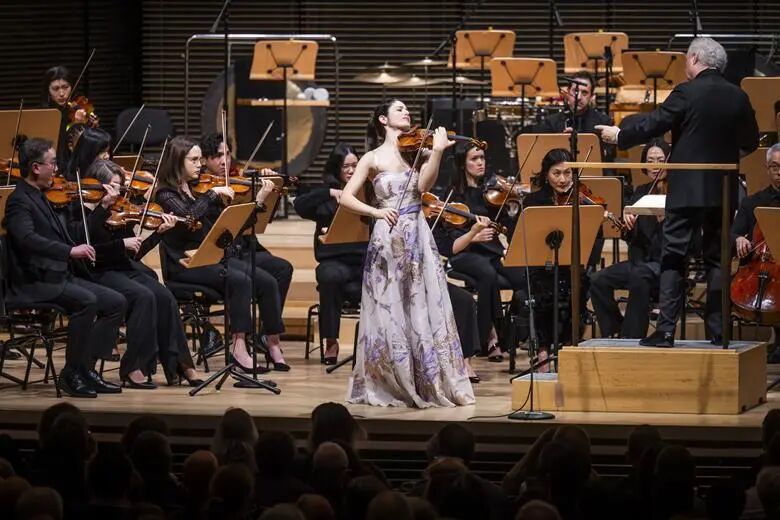
达维娜·舒姆(Davina Shum)从曼哈顿的周末之旅中发回报道,揭示了这座城市对小提琴的深厚情谊——从德意志留声机独家签约的玛丽亚·杜埃尼亚斯(María Dueñas)在纽约爱乐乐团令人惊艳的首秀,到伊扎克·帕尔曼(Itzhak Perlman)在卡内基音乐厅的精彩演出。
在伦敦生活了十三年多,我常常忘记身边其实有多么丰富多彩的文化活动。在各种截止日期、通勤和演出安排之间,我很少有机会去欣赏这座城市源源不断的音乐会和活动。住在其他地方的朋友经常说:“住在伦敦一定很棒——有那么多事情可做!” 这话当然没错,但我常常对家门口发生的事情一无所知。
然而,最近一次纽约之行,我突然体会到了伦敦游客必定会有的感受:一种无限可能的氛围。这里有太多值得体验、观赏和探索的事物——而这一次,我决心不再像个本地人,而更像一个充满好奇的新来者。
仅上周末,我就完美地领略了这座城市丰富的音乐资源,尤其是在小提琴领域。周五晚上,我在林肯中心的戴维·格芬音乐厅欣赏了一场音乐会,23岁的小提琴家玛丽亚·杜埃尼亚斯与纽约爱乐乐团合作,在她的长期导师曼弗雷德·霍内克的指挥下,演奏了贝多芬小提琴协奏曲。
仅仅两天后,在南边十个街区外的卡内基音乐厅,我欣赏了科罗拉多交响乐团的音乐会,传奇指挥家伊扎克·帕尔曼与乐团音乐总监彼得·翁德吉安联袂演出。
这两场演出都意义非凡。杜埃尼亚斯首次与纽约爱乐乐团合作,此前她已凭借比赛的胜利、广受好评的唱片以及繁忙的国际演出日程,建立了令人瞩目的职业生涯。去年刚过完八十岁生日的帕尔曼与翁德吉安同台献艺,这场演出充分展现了他们数十年的友谊和专业合作关系。
杜埃尼亚斯在吴蔡剧院以优雅流畅的演奏诠释了贝多芬的作品——温暖的音响效果突显了她那把1718年“米开朗基罗·塞凯伊”斯特拉迪瓦里小提琴在高音区的银铃般共鸣,以及乐团低音弦乐在强劲乐段中铿锵有力的音色。演出结束后,观众数次起立鼓掌,她随即加演了哈尔沃森《马赛克组曲》第四首《维斯勒莫伊之歌》。
@伊扎克·帕尔曼与彼得·翁德吉安和科罗拉多交响乐团合作演出
相比之下,帕尔曼的音乐会则更像是一场私密的沙龙。他以他标志性的机智和自嘲式的幽默介绍每一首作品,并与翁德吉安进行快速的玩笑:“我不记得排练过这首曲子,你呢?”他的节目包括一些短小精悍、深受观众喜爱的曲目——克莱斯勒的小品、约翰·威廉姆斯的《辛德勒的名单》主题曲和加德尔的《探戈(Por Una Cabeza)》——他说道:“这些曲子不需要返场,因为它们本身就是返场曲目。”
这些作品很少以完整的管弦乐队而非钢琴独奏的形式呈现。指挥家奥恩吉安经常蹲在指挥台上,反复提醒科罗拉多交响乐团的精简阵容保持轻盈的音色。虽然帕尔曼的音量或许不如他早年那样浑厚有力,但他鲜明的个人风格和极具表现力的演奏却丝毫未减。这一点在他演奏《辛德勒的名单》时体现得尤为淋漓尽致,赢得了纽约观众的阵阵喝彩。
这两场音乐会风格迥异:一场展现了年轻音乐家令人眼花缭乱的精湛技艺,另一场则邀请听众沉浸其中;一场标志着一颗冉冉升起的新星的崛起,另一场则颂扬了一位文化偶像的永恒艺术成就。然而,两场音乐会都充满了音乐合作的力量——杜埃尼亚斯和霍内克巩固了她们的合作关系,这种合作关系塑造了她年轻的职业生涯;帕尔曼和奥恩吉安则重续了他们数十年来在教学、音乐创作和相互欣赏中建立起来的深厚情谊。
整个周末最令我印象深刻的不仅是演出的高水准,更是纽约观众们的热情——这座城市对小提琴的热爱可谓无微不至,从勇于突破的年轻艺术家到备受爱戴的大师,无不体现着这座城市对小提琴的无限热爱。在许多人寻求慰藉、灵感和情感联结的当下,纽约对小提琴的这份执着显得尤为珍贵。
这份喜悦还将继续:本月晚些时候,林肯中心室内乐协会将举办一年一度的冬季音乐节——“小提琴庆典”(2月19日至3月8日),届时必将再次展现这座城市对小提琴以及赋予它生命的艺术家们的深切珍视。
Two concerts, one city: New York’s love for the violin. Davina Shum reports back from a weekend in Manhattan, which revealed the city’s deep devotion to the violin – from María Dueñas’s dazzling New York Philharmonic debut to Itzhak Perlman’s intimate turn at Carnegie Hall. Having lived in London for over 13 years, I often forget just how much cultural life is happening around me at any given moment. Between deadlines, commutes and my own performance commitments, I rarely have the chance to enjoy the city’s constant stream of concerts and events. Friends who live elsewhere often say, ‘It must be incredible living in London – there’s so much to do!’ And while that’s certainly true, I’m often completely out of the loop about what’s happening right on my doorstep.
On a recent trip to New York City, however, I suddenly felt what visitors to London must experience: a sense of endless possibility. There is so much to do, see and explore – and this time, I was determined to act less like a resident and more like a curious newcomer. Last weekend alone offered a perfect snapshot of the city’s musical abundance, especially in the violin world. On Friday evening, I attended a concert at David Geffen Hall at Lincoln Center, where 23‑year‑old violinist María Dueñas performed the Beethoven Violin Concerto with the New York Philharmonic under the baton of her long‑time mentor, Manfred Honeck. Just two days later and ten blocks south, I was at Carnegie Hall for the Colorado Symphony Orchestra’s concert, featuring the legendary Itzhak Perlman performing with the orchestra’s music director, Peter Oundjian. Both events carried a sense of occasion. Dueñas was making her New York Philharmonic debut, having already built an impressive career through competition wins, acclaimed recordings and a busy international schedule. Perlman, who celebrated his 80th birthday last year, appeared alongside Oundjian in a performance that showcased their decades‑long friendship and professional partnership.
Dueñas offered a gracefully fluid reading of Beethoven in the Wu Tsai Theater – a warm acoustic that highlighted the silvery resonance of her 1718 ’Székely, Michelangelo’ Stradivari violin in its highest register and the incisive bite of the orchestra’s lower strings in more forceful moments. Several standing ovations followed, prompting her to offer an encore: Song of Veslemoy, no.4 from Halvorsen’s Mosaique Suite. Perlman’s concert, by contrast, felt almost like an intimate salon. He introduced each work with his trademark wit and self‑deprecating humour, exchanging quick-fire banter with Oundjian: ‘I don’t remember rehearsing this piece, do you?’ His programme consisted of short, crowd‑pleasing favourites – Kreisler miniatures, John Williams’s Theme from Schindler’s List, and Gardel’s Tango (Por Una Cabeza) – remarking that ‘you don’t need an encore for these pieces because they already are encores.’ It is rare to hear these works performed with full orchestra rather than piano. Oundjian, often crouched on the podium, repeatedly urged the reduced forces of the Colorado Symphony to keep textures light. While Perlman may not project with the dynamic heft of his earlier years, what remains undiminished is his unmistakable character and expressive authority. This was heard most poignantly in his Schindler’s List performance, which drew noises of appreciation from the New York audience.
The two concerts could not have been more different: one dazzled with youthful virtuosity, the other invited listeners to lean in; one marked the ascent of a rising star, the other celebrated the enduring artistry of a cultural icon. Yet both evenings were steeped in the power of musical partnerships – Dueñas and Honeck cementing a collaboration that has shaped her young career, and Perlman and Oundjian renewing a bond forged through decades of teaching, music-making and mutual admiration. What struck me most over the course of the weekend was not just the quality of the performances, but the sheer enthusiasm of New York audiences – a city that embraces the violin in all its forms, from boundary‑pushing young artists to beloved masters. At a time when many seek solace, inspiration and connection through live performance, New York’s devotion to the violin feels especially vibrant. And the celebration continues: later this month, the Chamber Music Society of Lincoln Center launches its annual Winter Festival, A Violin Celebration (19 February to 8 March), promising yet another reminder of how deeply this city cherishes the instrument and the artists who bring it to life.