
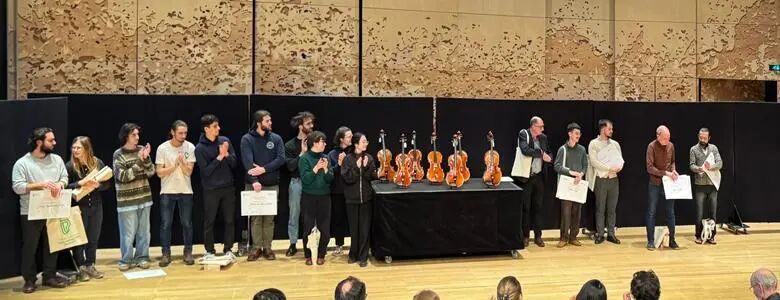
安德烈亚斯·汉佩尔荣获最高奖项,皮奥特·皮耶拉谢克、马库斯·克利姆克和乔纳森·马格尔也获得奖项。
2026年国际中提琴制作大赛于2026年1月14日至18日在巴黎爱乐音乐厅举行。德国制琴师安德烈亚斯·汉佩尔荣获一等奖,并获得音质特别奖。二等奖由波兰制琴师皮奥特·皮耶拉谢克获得,他还获得了制琴师评审团颁发的特别奖。三等奖由法国的马库斯·克利姆克和德国的乔纳森·马格尔共同获得,他们还获得了巴黎管弦乐团成员颁发的特别奖。
颁奖典礼结束后,汉佩尔表示,获得一等奖让他“感到荣幸,也同样激动”。“我非常感激,这对我妻子苏珊娜和我过去几十年的工作来说是极大的肯定。”
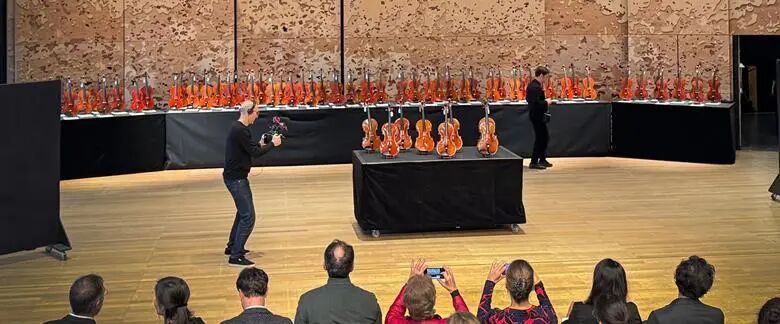
巴黎爱乐乐团展示的参赛中提琴。照片:苏珊·里贝塞尔
制琴师评审团由 Jonathan Marolle、Ibiza Avalos 和 Riccardo Angeloni 组成,演奏家评审团则由 Pauline Sachse、Miguel da Silva 和 Ana Bela Chaves 组成。共有 63 位制琴师提交乐器参赛,评审团在三天内对这些乐器进行了检查、演奏和评估。得分最高的 15 件乐器随后由巴黎管弦乐团的成员进行公开盲测演奏,评审团从中选出了最终的八件乐器。这八件乐器在总决赛的公开音乐会上再次进行盲测演奏,观众也可以通过投票选出自己最喜欢的乐器。
此外,还举办了一项名为“明日之星”的附加比赛。在这项比赛中,第一名和第二名均由米尔库尔国家制琴学校的学生获得,第三名则由瑞士布里恩茨小提琴制作学校的代表获得,他们还获得了制琴师评审团颁发的特别奖。
据汉佩尔介绍,这把获得一等奖的中提琴(见上图)是“我对斯特拉迪瓦里1672年‘古斯塔夫·马勒’型号的诠释。我以原始模具的扫描图为基础,将其尺寸重新绘制为415毫米。虽然我做了一些改动(例如,琴背使用了枫木而不是白杨木,并且制作了一个没有琴肩的琴头),但整把中提琴仍然散发出斯特拉迪瓦里的线条和美学风格。油性清漆呈精致的红棕色,并带有明显的磨损痕迹。这把中提琴并非旨在复制原作,而是为了展现我们喜爱的那种美丽古老乐器上木材和清漆所呈现出的柔和磨损感。”
Winners announced at Philharmonie de Paris 2026 viola making competition. Andreas Hampel took the top prize in the French capital, with Piotr Pielaszek, Marcus Klimke and Jonathan Magerl also picking up awards The 2026 International Viola Making Competition took place at the Philharmonie de Paris from 14 to 18 January 2026. German luthier Andreas Hampel took the first prize, as well as a special audience prize for sound quality. The second prize was taken by Polish luthier Piotr Pielaszek, who also received a special prize from the luthiers’ jury. Third prize went jointly to Marcus Klimke of France and Jonathan Magerl of Germany, who additionally received a special prize from the members of the Orchestre de Paris.
Following the awards ceremony, Hampel said he was ‘honoured and equally thrilled’ to have received the first prize. ‘I am very grateful, and see this as a great recognition of the work that my wife Susanne and I have done over the past decades.’The luthiers’ jury comprised Jonathan Marolle, Ibiza Avalos and Riccardo Angeloni, while the players’ jury was made up of Pauline Sachse, Miguel da Silva and Ana Bela Chaves. A total of 63 makers submitted instruments for the competition, which were examined, played and evaluated over three days. The 15 highest-rated instruments were then played by members of the Orchestre de Paris in a public blind test, when the jury chose the final eight instruments. These were then played in a public concert for the grand final, also in a blind test, where the audience were also able to select their favourites by ballot.
In addition, there was a secondary competition for ‘the talents of tomorrow’. In this contest, both the first and second prizes were won by students at the Ècole Nationale de Lutherie de Mirecourt, while the third prize was taken by representatives of the Swiss Violin Making School Brienz, who also received a special prize from the violin makers’ jury. According to Hampel, the first prize-winning viola (above) ‘my interpretation of Stradivari’s 1672 ‘Gustav Mahler’ model. Starting from a scan of the original mould, I redrew it to 415mm size. Although I made other alterations (such as using maple for the back instead of poplar, and making a scroll without shoulders), the whole viola still radiated Stradivari lines and aesthetics. The oil varnish is a delicate reddish-brown colour, with clear signs of wear. The viola is not intended to be a copy, but rather to show the soft wear in the wood and varnish that we love in beautiful old instruments.’